

2026 Best WiFi Communication Modules for Global Buyers
The 2026 market for connected products is becoming more demanding, not simply larger. Wi-Fi Alliance’s global economic impact research valued Wi-Fi’s contribution at about $4.9 trillion in 2023. Its forecast expects this contribution to approach $5.5 trillion by 2025. These figures show why a reliable Wifi Communication Module matters in homes, factories, retail systems, and medical equipment. Connectivity is now part of product performance.
Yet global buyers should avoid choosing modules by speed alone. The IoT Analytics State of IoT research estimated 18.8 billion connected IoT devices in 2024. Many operate in crowded buildings, remote warehouses, or regions with unstable power. A module that performs well on a laboratory desk may behave differently behind metal panels. Small details matter, including antenna layout, thermal control, roaming support, and firmware maintenance. They are easy to overlook.
Security also deserves practical attention. NIST guidance recommends strong identity management, secure updates, and lifecycle planning for connected devices. Buyers should therefore compare Wi-Fi 6 and Wi-Fi 6E support, operating temperature, power consumption, certification coverage, and long-term software support. WPA3 capability is useful, but it does not repair poor product design. Certification does not guarantee every real-world result.
This guide evaluates the best options for global buyers in 2026. It considers performance, integration effort, supply stability, documentation, and total ownership cost. No single module wins every project. That assumption is easy to make, and often wrong. A low-cost choice may create expensive redesign work later. Careful testing remains essential.
Wi-Fi Modules Defined: SoCs, Chipsets, Antennas, and Certified Designs
2026 Best WiFi Communication Modules for Global Buyers
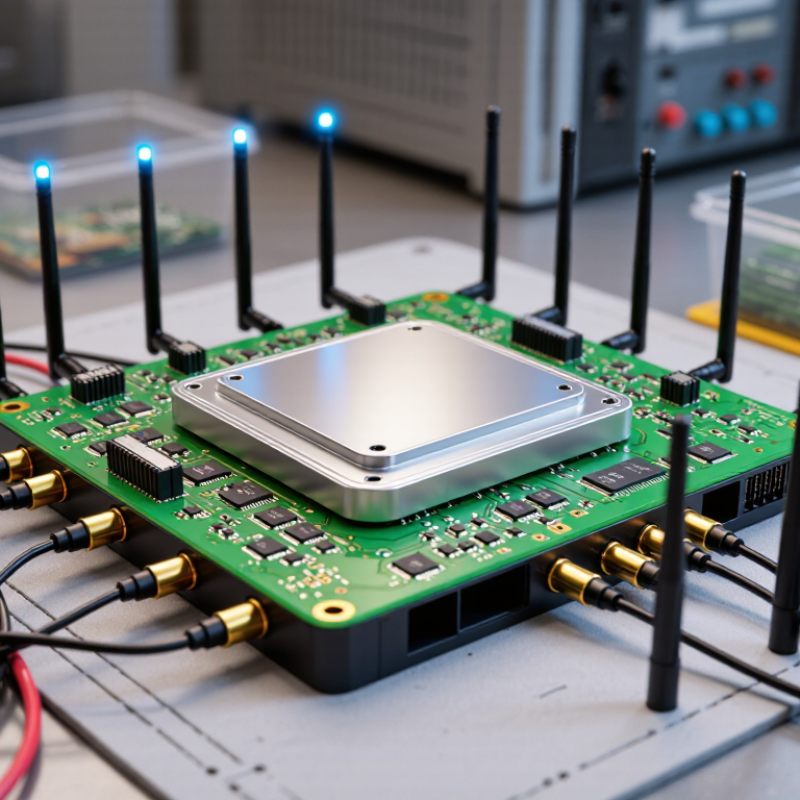
A Wi-Fi module is more than a small radio board. It combines an SoC, memory, firmware, power control, and wireless interfaces. The SoC handles computing, security functions, and network timing. A separate chipset may manage radio processing, especially in designs supporting multiple bands or advanced channels.
Antennas deserve equal attention. A powerful chipset cannot fix poor antenna placement. Keep copper, batteries, and metal shields away from the antenna clearance zone. In practical testing, a few millimeters can change throughput across a plastic enclosure. Check 2.4 GHz, 5 GHz, and, where required, 6 GHz performance. Certified designs can reduce approval work, but certification does not guarantee strong performance in every enclosure. Thermal behavior, UART or SPI compatibility, and long-term firmware support also need verification. I once underestimated heat near a sealed housing. The result was unstable throughput. That mistake was avoidable.
Tips: Request full test reports, not only specification sheets. Compare conducted and over-the-air results. Confirm regional approvals for every target market. Review antenna layouts with an RF engineer. Test through walls, inside the final enclosure, and during peak traffic. A prototype may pass indoors yet fail beside industrial equipment. Leave design margin. Real installations are rarely perfect.
| Module Architecture | Typical Wi-Fi Generation | Frequency Bands | Representative Spatial Configuration | Typical Peak PHY Rate | Common Host Interface | Typical Antenna Arrangement | Security and Protocol Features | Best-Fit Applications | Global Certification Considerations |
|---|---|---|---|---|---|---|---|---|---|
| Wi-Fi System-on-Chip module | Wi-Fi 4 or Wi-Fi 5 | 2.4 GHz; selected designs also support 5 GHz | 1×1 single-stream | Up to approximately 72.2 Mbps at 20 MHz or 150 Mbps at 40 MHz for Wi-Fi 4; up to approximately 433 Mbps at 80 MHz for Wi-Fi 5 | SPI, SDIO, UART, or USB, depending on design | Single PCB antenna, chip antenna, or external antenna connector | WPA2-Personal; WPA3 support depends on the wireless silicon and software stack | Smart sensors, appliances, meters, entry-level industrial controllers, and low-cost connected products | Usually the lowest hardware cost; approval depends strongly on antenna type, output power, enclosure, and regional radio rules |
| Wi-Fi chipset module with external host processor | Wi-Fi 5 | 2.4 GHz and 5 GHz | 1×1 or 2×2 MIMO | Approximately 433 Mbps for 1×1 or up to approximately 867 Mbps for 2×2 at 80 MHz | SDIO, PCIe, USB, or high-speed serial interface | Two-antenna diversity or 2×2 MIMO; internal or external antenna options | 802.11ac, WPA2, WPA3 on supported software platforms, IPv4, and IPv6 | Industrial gateways, point-of-sale equipment, displays, networking devices, and embedded Linux products | Provides higher throughput than basic single-stream designs; the host processor must provide compatible drivers and security maintenance |
| Wi-Fi 6 low-power module | Wi-Fi 6 | 2.4 GHz and 5 GHz | 1×1 single-stream | Up to approximately 600 Mbps at 80 MHz under ideal 1024-QAM conditions | SDIO, SPI, UART, or USB | One integrated antenna or one external antenna | OFDMA, Target Wake Time, BSS Coloring, WPA3, and enhanced power-saving options | Battery-powered sensors, smart-home products, portable instruments, and energy-sensitive industrial devices | Good choice when power efficiency and dense-network performance matter more than maximum throughput |
| Wi-Fi 6 dual-stream module | Wi-Fi 6 | 2.4 GHz and 5 GHz | 2×2 MIMO | Up to approximately 1.2 Gbps at 80 MHz under ideal 1024-QAM conditions | PCIe, SDIO, USB, or an integrated processor bus | Two spatially separated antennas; diversity is recommended for stable performance | OFDMA, MU-MIMO, BSS Coloring, Target Wake Time, WPA3, and Protected Management Frames | Wireless gateways, video terminals, industrial HMIs, smart displays, and high-density office equipment | Requires careful RF layout and antenna isolation; actual throughput is lower than the theoretical PHY rate in normal environments |
| Wi-Fi 6E tri-band module | Wi-Fi 6E | 2.4 GHz, 5 GHz, and 6 GHz | 1×1 or 2×2 MIMO | Up to approximately 2.4 Gbps for 2×2 operation at 160 MHz under ideal conditions | PCIe, USB, SDIO, or integrated SoC interfaces | Dedicated antenna paths for 2.4/5 GHz and 6 GHz; antenna certification limits must be checked | Wi-Fi 6 OFDMA, WPA3, Protected Management Frames, and access to additional 6 GHz channels where permitted | Low-latency enterprise devices, AR/VR equipment, professional video systems, and high-density wireless networks | 6 GHz availability and indoor/outdoor operating rules differ by country; older devices may not support the 6 GHz band |
| Wi-Fi 7 performance module | Wi-Fi 7 | 2.4 GHz, 5 GHz, and 6 GHz where legally available | 2×2 MIMO is common in embedded designs | Up to approximately 5.76 Gbps for 2×2 operation at 320 MHz with 4096-QAM under ideal conditions | PCIe, USB, or a high-speed integrated processor interface | Multiple antenna paths with strict layout, isolation, and coexistence requirements | 320 MHz channels, 4096-QAM, Multi-Link Operation, enhanced scheduling, WPA3, and Protected Management Frames | Premium gateways, wireless video, industrial automation, cloud gaming, and demanding enterprise equipment | Requires advanced RF design, updated operating-system support, and country-specific review of 6 GHz and high-power operation |
| Certified pre-approved radio module | Wi-Fi 4 through Wi-Fi 7, depending on module design | Single-band, dual-band, or tri-band | 1×1, 2×2, or higher-order MIMO | Determined by the installed wireless chipset, antenna configuration, channel width, and regulatory power limit | USB, SDIO, PCIe, UART, or a processor-specific interface | Approved internal antenna or listed external antenna combinations | WPA2, WPA3, secure boot, firmware signing, and enterprise authentication may be available | Products that need shorter market-entry time, including medical, industrial, consumer, and commercial equipment | Existing approvals can reduce testing effort, but the final product must follow the approved antenna, layout, shielding, power, and installation conditions |
| Chipset reference design for custom certification | Any supported Wi-Fi generation | Selected bands based on the radio front end | Configured by the product designer | Depends on modulation, channel width, transmit power, antenna gain, and spatial streams | Selected according to the host processor and operating system | Custom PCB, ceramic, printed, dipole, or external antenna design | Flexible support for WPA3, enterprise authentication, secure firmware, and customized network features | High-volume products, specialized industrial equipment, routers, gateways, and mechanically constrained devices | Offers maximum design flexibility but normally requires full RF validation, regulatory testing, coexistence testing, and regional certification |
| Wi-Fi and Bluetooth combo module | Wi-Fi 4, Wi-Fi 5, Wi-Fi 6, or Wi-Fi 7 with Bluetooth support | 2.4 GHz Wi-Fi and Bluetooth; 5 GHz or 6 GHz may also be included | Usually 1×1 Wi-Fi; Bluetooth uses a shared or dedicated radio path | Wi-Fi rate depends on the supported generation; Bluetooth data rates are substantially lower than Wi-Fi PHY rates | UART, USB, SDIO, PCIe, or shared host interfaces | Shared 2.4 GHz antenna with coexistence control; additional antennas may be used for higher Wi-Fi performance | WPA2/WPA3 for Wi-Fi and secure pairing, encryption, and authenticated connections for Bluetooth | Wearables, healthcare instruments, smart appliances, automotive accessories, and consumer electronics | Requires coordinated Wi-Fi/Bluetooth coexistence testing and separate consideration of regional radio and short-range-device requirements |