How to Choose a Commercial Kitchen Range in 2026?
Choosing a Commercial Kitchen Range in 2026 requires more than comparing burner counts and glossy specifications. The right range must match your menu, service volume, kitchen layout, ventilation system, and staff habits. A six-burner model may suit a busy bistro, while a compact four-burner unit could serve a café more efficiently. Bigger is not always better.
This guide examines practical factors that affect daily performance. We will consider gas, electric, and induction cooking, along with heat control, oven capacity, cleaning access, energy use, safety features, and maintenance support. Pay attention to small details. Can cooks reach every control without crossing hot pans? Does the oven recover heat during a dinner rush? Can technicians access replaceable parts without dismantling half the unit?
Reliable decisions also require verified information. Check manufacturer documentation, warranty terms, installation requirements, and applicable commercial safety standards before ordering. Local ventilation and utility conditions can change the final cost. That part is often underestimated. A range that looks affordable online may require expensive electrical upgrades, gas work, or hood modifications.
No buying guide can predict every kitchen. Menus change. Staff skills vary. Even experienced operators sometimes choose equipment that performs well on paper but feels awkward during service. Use the recommendations here as a structured starting point, then test shortlisted models with your actual pans, recipes, and workflow. Good equipment should support the team quietly, consistently, and safely.
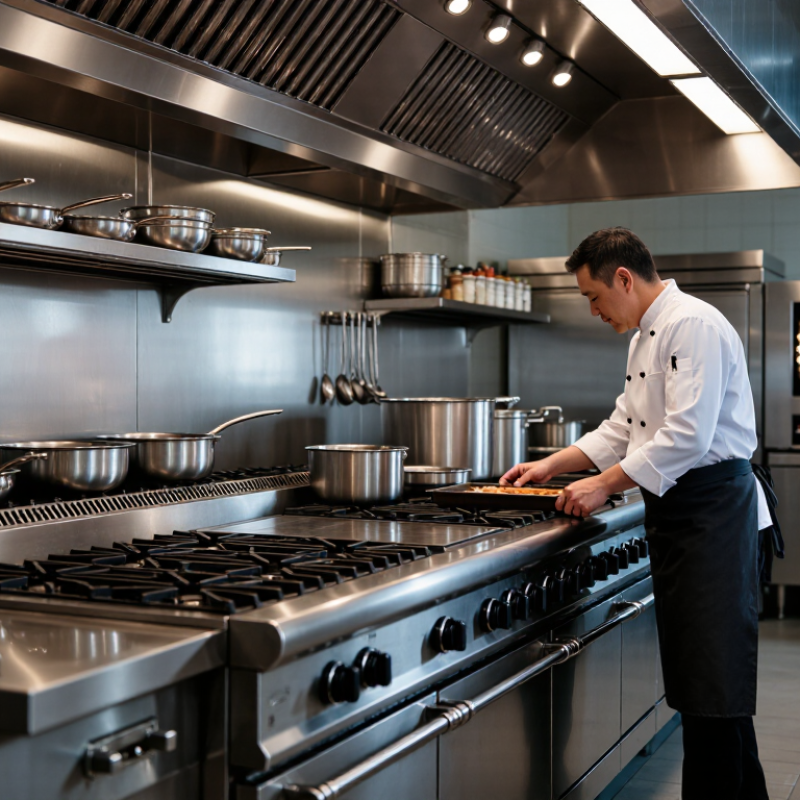
Define Cooking Demand with BTU/h, kW, Pan Capacity, and Peak-Meal Volume
Choosing a commercial kitchen range in 2026 starts with measuring real cooking demand, not guessing from floor size. Record your busiest meal period for at least one week. Count plates, pans, sauces, and cooking cycles during that rush. Measure the rush.
BTU/h describes gas heat input, while kW describes electrical power or heating capacity. As a practical reference, 1 kW equals approximately 3,412 BTU/h. A higher rating can shorten recovery time, but it may also increase fuel use and ventilation demands. Match output to the food you actually cook. A range producing 120,000 BTU/h is unnecessary if only two burners operate during peak service. Heat is not everything.
Pan capacity exposes another common mistake. A six-burner range may sound adequate, yet large stockpots can block neighboring burners. Check the grate spacing, usable burner area, oven volume, and maximum pan dimensions. Then compare these details with peak-meal volume. If your kitchen serves 180 meals in one hour, estimate how many pans must finish within each 15-minute window. I once underestimated this step and selected strong burners with insufficient working space. The range performed well, but staff lost time rearranging pans. That mistake is common. Leave some capacity for sudden orders, seasonal demand, and slower cooks. Review technical sheets, confirm measured output, and ask a qualified installer to verify gas, electrical, ventilation, and clearance requirements before purchase.
How to Choose a Commercial Kitchen Range in 2026? - Define Cooking Demand with BTU/h, kW, Pan Capacity, and Peak-Meal Volume
| Range Profile | Typical Burner Layout | Total Input
BTU/h | Approx. Input
kW | Approx. Input per Burner
BTU/h | Oven Capacity
Full-Size Pans | Indicative Peak-Meal Volume
Meals/hour | Recommended Operating Demand |
| Compact Light-Duty | 4 open burners | 90,000 | 26.4 | 18,000–24,000 | 2–3 | 30–50 | Cafés, small foodservice counters, limited menus, and low-volume breakfast or lunch service. |
| Standard Medium-Duty | 6 open burners | 150,000 | 44.0 | 20,000–30,000 | 3–4 | 50–90 | Small restaurants and institutional kitchens with several simultaneous sauté, simmer, and boiling tasks. |
| High-Output Restaurant | 6 burners plus griddle or hot top | 210,000 | 61.5 | 24,000–32,000 | 4–6 | 80–130 | Busy casual dining, hotel kitchens, and menus requiring simultaneous pan cooking, griddling, and oven finishing. |
| Heavy-Duty Production | 8 burners plus griddle or hot top | 300,000 | 87.9 | 25,000–35,000 | 6–8 | 120–180 | High-volume restaurants, catering production, healthcare kitchens, and operations with strong peak-period demand. |
| Extra-Heavy Production | 10 burners plus large griddle or hot top | 450,000 | 131.9 | 28,000–40,000 | 8–10 | 180–260 | Large production kitchens and high-volume service where multiple cooking stations operate continuously. |
| Planning notes: BTU/h is the appliance gas-input rating; kW values are approximate input equivalents calculated using 1 kW = 3,412 BTU/h. Actual cooking output depends on burner efficiency, pan size, food type, recovery time, ventilation, staff workflow, and local gas pressure. Full-size pan capacity refers to standard gastronorm or hotel-pan positions that can fit in the oven cavity; verify the exact pan dimensions before purchase. Peak-meal figures are practical planning ranges for meals containing multiple components and should be adjusted using the kitchen’s actual menu, batch sizes, service window, and preparation method. |
Compare Gas, Electric, and Induction at 35–90% Thermal Efficiency
How to Choose a Commercial Kitchen Range in 2026?
Thermal efficiency should guide your choice, but it should not decide everything. Gas ranges typically deliver about 35–40% efficiency, with heat escaping around the cookware. They offer responsive flame control and suit kitchens that need visual heat adjustment. Electric ranges often reach 70–75% efficiency. Their flat surfaces provide steady heat and simpler cleaning. However, recovery can feel slow during busy service.
Induction commonly reaches 80–90% efficiency because it heats compatible pans directly. Less heat enters the room, which can improve comfort near the cooking line. It also supports precise temperature changes. Heat disappears. Yet induction requires suitable cookware and dependable electrical capacity. A site assessment should confirm voltage, circuit load, ventilation, and available counter space before purchase.
The neat percentage chart is useful, but imperfect. Actual performance changes with pan size, food volume, lid use, and staff technique. A half-empty pan wastes energy on any range. During a practical evaluation, test a full stockpot, a sauté pan, and repeated high-volume cooking. Record recovery time, surface temperature, and room comfort. Gas may outperform expectations in speed. Electric may prove easier to maintain. Induction may expose weaknesses in the building’s power supply. Check service access and cleaning routines too. The cheapest installation can become expensive when downtime, ventilation demand, or electrical upgrades appear later. A reliable decision balances thermal efficiency with workflow, safety controls, maintenance skill, and daily cooking habits.
How to Choose a Commercial Kitchen Range in 2026?
Compare Gas, Electric, and Induction at 35–90% Thermal Efficiency
Induction transfers the highest share of input energy directly to compatible cookware, while conventional electric resistance ranges typically perform better than gas but below induction. Gas ranges release more heat into the surrounding kitchen, which can increase ventilation and cooling loads. Actual results vary with cookware, pan size, cooking method, load, and ventilation design.
Representative thermal-efficiency values: gas 35%, electric resistance 75%, and induction 90%. Values are typical industry estimates rather than brand-specific performance claims.
Match Range Output and Footprint to Kitchen Workflow and Available Space
How to Choose a Commercial Kitchen Range in 2026?
Match Range Output and Footprint to Kitchen Workflow and Available Space
A commercial range should fit the kitchen’s rhythm, not just its menu. High-output burners suit boiling, sautéing, and heavy lunch service. However, excessive power can waste energy and overheat a compact room. Measure the cooking line, aisle width, hood position, and nearby refrigeration before choosing equipment. Leave enough clearance for staff to turn safely with full pans.
Think in workflow zones. A busy breakfast station may need several fast burners and a griddle. A smaller prep kitchen might perform better with fewer burners and a wider work surface. Heat output is commonly listed in BTU or kilowatts, but these figures do not tell the whole story. Pan size, recovery time, ventilation, and staff habits also affect performance. A range that looks powerful on paper may slow service if cooks constantly cross the room.
Tips: Sketch the kitchen at full scale. Mark door swings, waste bins, landing space, and the path from storage to the range. Test the layout with empty boxes before ordering. Ask an experienced installer to verify ventilation, gas or electrical capacity, and local safety requirements. You may still misjudge peak demand. That is normal. Review one week of ticket data instead of trusting assumptions. A modest range with clear movement often outperforms a larger unit placed in the wrong corner.
Verify NSF/ANSI 4, UL 197, and NFPA 96 Compliance Requirements
Choosing a commercial kitchen range in 2026 requires more than checking burner output or oven capacity. Start with NSF/ANSI 4 documentation for commercial cooking equipment sanitation. Look for smooth, cleanable surfaces, sealed joints, and accessible service areas. Ask the supplier for the exact certification scope, not a general compliance statement. Small details matter. A poorly designed corner can collect grease and food residue.
For electrically heated ranges, verify UL 197 certification and its applicable conditions. Confirm voltage, amperage, grounding, and clearance requirements before ordering. A range may fit the menu but overload an existing circuit. I have seen equipment specifications reviewed too late, forcing costly electrical changes. That mistake is avoidable. For gas equipment, request the relevant safety approvals separately, because UL 197 does not cover every fuel type.
Tips: Keep the data plate, installation manual, and certification records together. Compare the range with the exhaust system designed under NFPA 96. Check hood size, airflow, grease filters, fire suppression interfaces, and required clearances. NFPA 96 compliance affects more than the hood; it can influence placement, ductwork, and maintenance access. Have a qualified installer and the local authority having jurisdiction review the layout. Paperwork can look complete while a clearance remains wrong. Leave room for cleaning. That decision usually proves useful.