

How to Choose Plastic Enclosures in 2026?
Choosing the right Plastic Enclosures in 2026 requires more than comparing prices or wall thickness. The enclosure must protect electronics from impact, moisture, dust, heat, chemicals, and careless handling. According to MarketsandMarkets’ Electrical Enclosure Market report, global demand is expected to grow steadily through 2028, supported by industrial automation, renewable energy, and connected devices. This growth creates more options, but also more room for poor decisions.
Start with the real operating environment. A control box beside a cooling tower faces condensation and chemical residue. A handheld medical device needs light weight, smooth edges, and reliable cleaning resistance. For outdoor installations, review UV stability, sealing performance, and the applicable IP rating under IEC 60529. NEMA 250 can also guide enclosure selection in North American projects. Do not treat these ratings as interchangeable. They describe related, but different, protection systems.
Material choice deserves careful testing. ABS may suit indoor electronics because it is economical and easy to mold. Polycarbonate usually offers stronger impact resistance and better transparency. Glass-filled nylon can perform well near heat and vibration, although it may cost more and complicate production. Grand View Research reports continued expansion in plastics used for electrical and electronic applications, driven by lightweight design and manufacturing efficiency. However, market growth does not guarantee product quality. It is a useful warning.
Ask for test data, not broad promises. Check hinge life, gasket compression, flame performance, mounting strength, and dimensional stability. Samples should face realistic dust, water, heat, and impact conditions. A perfect material rarely exists. The best choice balances protection, serviceability, compliance, and total lifecycle cost. That balance may change in 2026.
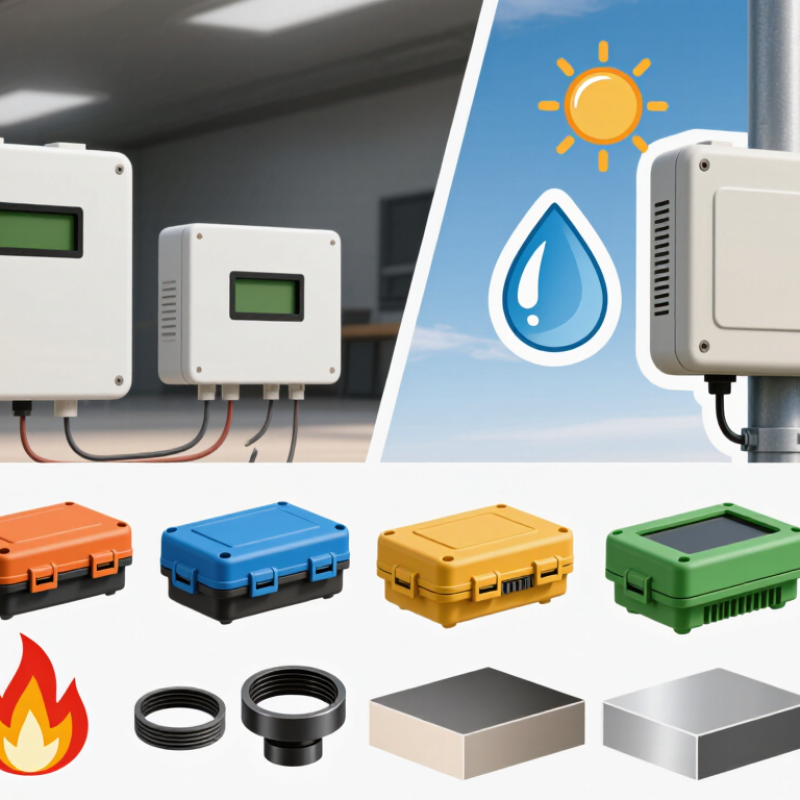
Define the Application, Environment, and Protection Requirements
How to Choose Plastic Enclosures in 2026?
Define the Application, Environment, and Protection Requirements
Choosing a plastic enclosure should begin with the device, not the catalogue photograph. What must it contain? A compact sensor needs different space than a power controller. Measure the circuit board, terminals, cable bends, and future service access. Leave practical clearance around heat-producing parts. Tight designs often look efficient, but they can make maintenance frustrating.
Study the installation environment carefully. Indoor equipment may face dust, condensation, cleaning fluids, vibration, or accidental impact. Outdoor equipment adds sunlight, rain, temperature swings, and insects. Polycarbonate can suit applications needing strong impact resistance, while ABS may work well for lighter indoor assemblies. However, material names alone prove little. Check temperature ratings, chemical resistance, UV performance, and the enclosure’s wall thickness.
Protection requirements must match real exposure. Select an appropriate IP rating for dust and water, then examine the gasket, hinges, screws, and cable glands as one system. A sealed box can still fail through an unsuitable cable entry. Test the assembled enclosure under realistic conditions. We sometimes overestimate protection because a sample passes a basic inspection. That assumption deserves challenge. Review mounting strength, grounding needs, ventilation, and flame performance before approval. Document the reasoning, including uncertainties, so future engineers can improve the decision.
| Application Profile | Recommended Plastic | Typical Operating Temperature | Outdoor and UV Suitability | Typical Protection Target | Impact and Mechanical Demand | Key Environmental Risks | Selection Priority | Practical Recommendation |
|---|---|---|---|---|---|---|---|---|
| Indoor control panels, building automation, and low-voltage electronics | ABS | Approximately −20°C to +60°C, depending on grade and design | Limited for continuous outdoor exposure unless UV-stabilized | IP40 to IP65 when the enclosure, cover, gasket, and cable entries are correctly designed | Good general-purpose rigidity and impact resistance | Heat, solvents, direct sunlight, dust, and accidental contact | Standard | Choose ABS for cost-sensitive indoor equipment where strong UV and chemical resistance are not primary requirements. |
| Industrial automation, meters, sensors, and electrical equipment exposed to knocks | Polycarbonate | Approximately −40°C to +120°C, depending on grade and enclosure construction | Good when a UV-stabilized or outdoor-rated grade is specified | IP65 to IP67 is commonly achievable with suitable seals and fittings | Very good impact resistance and dimensional stability | Mechanical shock, temperature cycling, dust, rain, and vibration | High | Use polycarbonate when impact protection, transparency, or a broad service-temperature range is important. |
| Outdoor telecom, energy monitoring, irrigation controls, and roadside electronics | UV-stabilized polycarbonate or ASA | Typically about −40°C to +85°C for finished products; verify the selected grade | Good to very good with UV-stabilized material, suitable color, and weather-resistant seals | IP65 to IP66; higher protection depends on joint and cable-entry design | Good resistance to impact, rain, and temperature changes | Solar radiation, condensation, driving rain, pollution, and thermal expansion | High | Specify UV exposure, color stability, drainage, breathable membrane requirements, and the complete outdoor sealing system. |
| Low-cost indoor junction boxes, terminal covers, and simple wiring protection | Polypropylene | Approximately −20°C to +80°C, depending on grade | Fair to limited unless UV-stabilized | IP55 to IP67 can be achieved in suitable designs | Good toughness and resistance to repeated flexing; lower stiffness than polycarbonate | Moisture, mild acids, bases, and repeated handling | Standard | Choose polypropylene for lightweight, moisture-resistant applications where high rigidity and premium appearance are not essential. |
| Equipment near oils, fuels, cleaning agents, or aggressive industrial chemicals | Polypropylene or chemical-resistant polyamide; verify compatibility | Commonly about −20°C to +100°C, depending on material and formulation | Material-specific; UV stabilization may be required outdoors | IP65 to IP67 when chemical-resistant seals and cable glands are used | Good toughness; final performance depends on chemical exposure and temperature | Solvent swelling, stress cracking, permeation, and seal degradation | High | Check a chemical compatibility chart using concentration, temperature, exposure time, and mechanical stress before final selection. |
| High-temperature electrical equipment, engine compartments, and heat-generating assemblies | High-temperature polycarbonate, polyamide, or specialized engineering plastic | Often approximately −40°C to +120°C; short-term limits may differ | Depends on grade, stabilizers, and surface exposure | IP54 to IP67, subject to gasket, vent, and cable-entry selection | Good when the material grade is selected for heat aging and mechanical load | Heat aging, thermal expansion, flammability, and reduced impact strength at low temperatures | High | Base the decision on continuous temperature, peak temperature, internal heat generation, and the required flammability rating. |
| Food-processing support equipment and washdown-prone areas | Polypropylene or suitable polycarbonate with compatible seals | Typically about −20°C to +80°C; confirm washdown temperature limits | Usually not the main requirement unless installed outdoors | IP66 to IP69K may be required for high-pressure or hot washdown applications | Good toughness; corners and fasteners must withstand repeated cleaning | Hot water, detergents, disinfectants, ingress through joints, and bacterial accumulation points | High | Use smooth, cleanable surfaces, corrosion-resistant hardware, hygienic cable entries, and seals rated for the cleaning chemicals. |
| Marine, coastal, and high-humidity installations | UV-stabilized polycarbonate or glass-fiber-reinforced polyester | Commonly about −40°C to +85°C, depending on construction | Good with appropriate UV stabilization and weather-resistant hardware | IP66 to IP67 is commonly selected for rain and splash exposure | Good impact resistance; reinforced polyester offers high rigidity | Salt spray, condensation, corrosion of hardware, and galvanic interaction | High | Specify marine-compatible hardware, sealed cable entries, condensation control, and corrosion-resistant mounting accessories. |
| Wireless devices, IoT gateways, and radio-connected control units | ABS, polycarbonate, or a material with suitable radio transparency | Typically about −20°C to +85°C, depending on electronics and material | Use UV-stabilized material for permanent outdoor placement | IP54 to IP67, balancing sealing with antenna performance and heat dissipation | Moderate to high, depending on installation location | Signal attenuation, condensation, heat buildup, dust, and tampering | High | Confirm antenna frequency performance, wall thickness, internal clearances, ventilation needs, and the required ingress rating together. |
| Portable instruments, handheld controls, and field-service equipment | Polycarbonate or polycarbonate/ABS blend | Approximately −30°C to +85°C, depending on grade | Moderate to good; select UV-stabilized material for outdoor field use | IP54 to IP67, depending on keypad, display, connectors, and seam design | Very good impact resistance and ergonomic molding potential | Drops, vibration, dust, rain, repeated opening, and connector wear | High | Prioritize drop testing, grip design, replaceable seals, connector protection, and practical access to batteries or service parts. |
| Electronic assemblies requiring electromagnetic shielding | Conductive-coated plastic or plastic with a conductive internal shielding system | Depends on the base plastic, coating, shielding method, and thermal design | Depends on coating durability and the selected base material | Ingress protection and EMC shielding must be evaluated separately | Depends on the underlying plastic and the shielding construction | Radiated emissions, immunity, grounding, coating wear, and discontinuities at seams | High | Plan the enclosure, gasket, cable shields, bonding points, and internal layout as one complete EMC system. |
| Flammable or safety-critical electrical environments | Material with the required flame-retardant classification and approved construction | Must be confirmed from the material data and applicable product standard | Application-specific; outdoor UV resistance may also be required | Specified by the relevant equipment and installation standard | Must meet both mechanical and fire-performance requirements | Ignition risk, heat buildup, flame spread, electrical faults, and combustible dust or gas | High | Do not select by material name alone; verify the exact flame rating, wall thickness, certification route, and installation conditions. |
| Selection note: IP ratings describe protection against solids and water under defined test conditions; they do not by themselves confirm UV resistance, chemical compatibility, impact performance, fire behavior, or long-term outdoor durability. Confirm the complete assembled enclosure, including the body, cover, gasket, hinges, fasteners, connectors, cable glands, vents, and mounting method, against the applicable IEC 60529 and product-specific requirements. | ||||||||