

Top 10 Stainless Steel Mesh Sheet Types to Buy?
Choosing the right Stainless Steel Mesh Sheet starts with more than comparing prices or browsing attractive product photos. Mesh count, wire diameter, opening size, alloy grade, and sheet thickness all affect performance. A fine 304 stainless steel sheet may suit filtration, while a heavier 316 option can better withstand salt spray and demanding outdoor conditions. The best choice depends on the environment, load, temperature, and cleaning method.
This guide examines ten practical stainless steel mesh types worth considering before you buy. It covers plain weave, twill weave, welded mesh, expanded mesh, perforated sheet, and several specialized designs. Each type offers a different balance of strength, airflow, visibility, corrosion resistance, and fabrication ease. Look closely. A small change in opening size can alter filtration results or airflow across an enclosure.
Reliable purchasing also requires evidence, not just confident descriptions. Check the material certificate, mesh tolerance, surface finish, and manufacturing standard. Ask whether the sheet was tested after welding or cutting. Inspect the edges; sharp burrs can complicate installation and create avoidable safety concerns. A reputable supplier should explain these details clearly and provide consistent samples.
There is no universal winner.
Even experienced buyers can misjudge a mesh sheet when they focus only on alloy grade. In some projects, 316 stainless steel adds unnecessary cost, while a properly specified 304 sheet performs well. This guide keeps that limitation visible, helping you compare real applications rather than follow a simple ranking. Examine the evidence, question vague specifications, and choose the type that matches your actual working conditions.
What Is Stainless Steel Mesh Sheet?
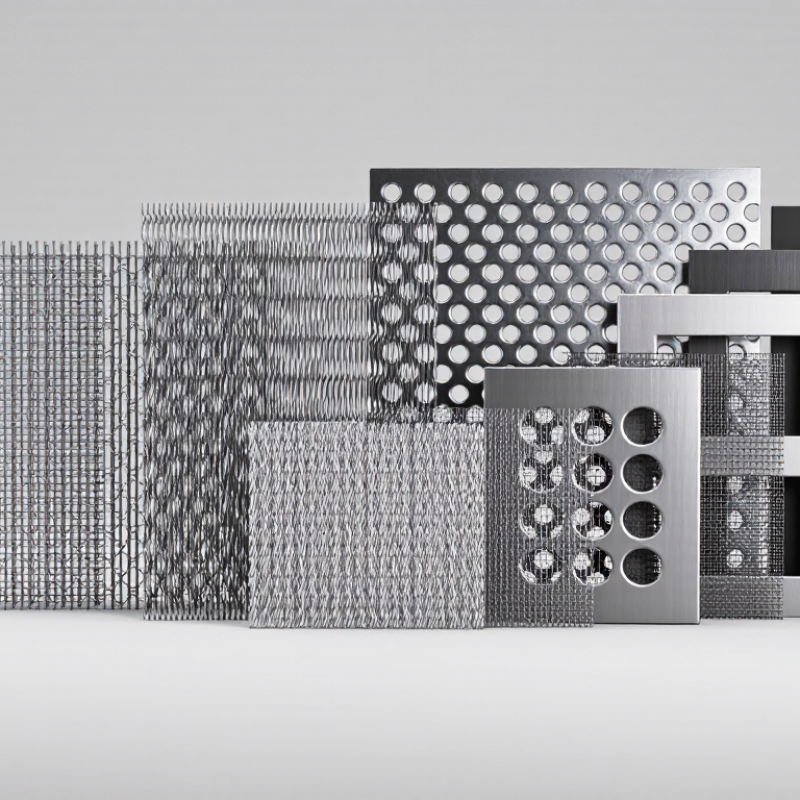
Stainless steel mesh sheet is a flat, open structure made from interlocked wires or welded metal strands. It is not the same as perforated sheet. Mesh forms repeated openings, while perforated sheet uses punched holes. Common options include woven mesh, welded mesh, expanded mesh, crimped mesh, and fine filter cloth.
The choice depends on aperture size, wire diameter, open-area percentage, and surface finish. Grade 304 suits many indoor and general industrial uses. Grade 316 offers stronger resistance to salt, moisture, and chemical exposure. ASTM E2016 and ISO 4783 provide useful guidance for describing wire cloth dimensions and mesh quality. In practice, measure the opening across the clear space, not from wire center to wire center. Small errors matter.
Market evidence supports continued demand. Grand View Research’s 2023 stainless steel market report projected a 7.4% compound annual growth rate from 2023 to 2030. A separate 2024 industry analysis estimated steady growth in stainless steel wire mesh, driven by filtration, construction, food processing, and safety applications. These figures describe broader markets, not every mesh sheet category. That distinction matters. A catalog may call two sheets “fine mesh,” yet their airflow and load performance can differ sharply. A 1.0-millimeter opening feels open to the eye, but it may clog quickly in dusty service. Always request aperture tolerance, wire diameter, grade certification, and a physical sample before buying.
Top 10 Stainless Steel Mesh Sheet Types to Buy? - What Is Stainless Steel Mesh Sheet?
| Rank | Stainless Steel Mesh Sheet Type | Manufacturing Method | Typical Opening or Mesh Range | Common Stainless Steel Grades | Typical Sheet Size | Key Advantages | Common Applications |
|---|---|---|---|---|---|---|---|
| 1 | Plain Weave Wire Mesh | Each warp wire passes alternately over and under each weft wire. | 20 mesh to 400 mesh; approximately 38 µm to 1.00 mm openings, depending on wire diameter. | 304, 304L, 316, 316L | Commonly supplied in rolls or cut sheets up to approximately 1.2 m × 30 m; custom sizes are available. | Balanced strength, accurate openings, broad availability, and easy fabrication. | Filtration, sieving, screening, ventilation panels, protective covers, and laboratory equipment. |
| 2 | Dutch Weave Mesh | Uses different wire diameters and wire counts in the warp and weft directions to create a dense filter structure. | Usually specified by micron retention rather than mesh count; approximately 5 µm to 250 µm filtration ratings. | 304, 316, 316L | Frequently supplied as rolls or precision-cut sheets; size depends on filtration specification. | High mechanical strength, fine filtration, and good resistance to pressure and particle migration. | Hydraulic filtration, polymer filtration, fuel filtration, chemical processing, and pressure screens. |
| 3 | Twill Weave Wire Mesh | Each wire passes over two and under two adjacent wires, producing a diagonal surface pattern. | Typically 20 mesh to 400 mesh; fine openings are possible with comparatively heavier wire. | 304, 304L, 316, 316L | Commonly available in rolls and cut panels, often up to about 1.5 m in width. | Higher load capacity than plain weave at similar mesh counts and good dimensional stability. | Fine screening, abrasive material separation, filter elements, and high-strength sieves. |
| 4 | Welded Wire Mesh Sheet | Longitudinal and transverse wires are resistance-welded at each intersection. | Typical apertures range from 6 mm to 100 mm; wire diameters commonly range from 1.0 mm to 6.0 mm. | 304, 304L, 316, 316L | Common panel sizes include 1.0 m × 2.0 m, 1.2 m × 2.4 m, and 1.5 m × 3.0 m. | Rigid construction, uniform openings, easy installation, and strong load-bearing performance. | Machine guards, partitions, cages, storage racks, animal enclosures, and architectural panels. |
| 5 | Expanded Metal Mesh Sheet | A solid stainless steel sheet is slit and stretched to form diamond-shaped openings without waste from punched-out material. | Short way of opening commonly 2 mm to 100 mm; thickness commonly 0.5 mm to 6.0 mm. | 304, 316, 316L | Typical panels range from approximately 1.0 m × 2.0 m to 1.5 m × 3.0 m. | High strength-to-weight ratio, slip resistance, ventilation, and a continuous integral structure. | Walkways, platforms, stair treads, safety screens, facades, ceilings, and equipment guards. |
| 6 | Perforated Stainless Steel Sheet | Round, square, slotted, or decorative holes are punched or laser-cut into stainless steel sheet. | Hole diameters commonly range from 0.5 mm to 20 mm; open area may range from about 20% to 60%. | 304, 304L, 316, 316L | Common sheet sizes include 1.0 m × 2.0 m, 1.2 m × 2.4 m, and 1.5 m × 3.0 m. | Consistent hole geometry, clean appearance, controlled airflow, and good rigidity. | Acoustic panels, screens, filters, ventilation covers, equipment housings, and architectural cladding. |
| 7 | Crimped Woven Mesh | Pre-crimped wires interlock at crossing points before or during weaving. | Openings commonly range from 3 mm to 100 mm; wire diameters commonly range from 1.0 mm to 10 mm. | 304, 304L, 316, 316L | Often supplied as cut panels up to approximately 2.0 m × 4.0 m, depending on wire diameter. | Strong, rigid, stable under vibration, and suitable for heavy-duty screening. | Quarry screens, mining screens, vibrating screens, aggregate separation, and security barriers. |
| 8 | Hexagonal Wire Mesh | Wires are woven or twisted to form a repeating hexagonal aperture pattern. | Typical hexagonal openings range from 13 mm to 80 mm; wire diameter commonly ranges from 0.7 mm to 2.5 mm. | 304, 316, 316L | Common roll widths range from 0.5 m to 2.0 m, with lengths often between 10 m and 30 m. | Flexible, lightweight, corrosion-resistant, and easy to shape around curved surfaces. | Animal enclosures, baskets, gabions, insulation retainers, erosion-control products, and ventilation guards. |
| 9 | Sintered Multi-Layer Mesh | Several woven mesh layers are stacked and sintered under heat and pressure to form a rigid laminate. | Typical filtration ratings range from approximately 1 µm to 200 µm. | 304, 316L | Commonly produced as discs, cylinders, cartridges, and sheets; sheet sizes are often customized. | High strength, stable filtration rating, cleanability, and resistance to pressure and temperature. | Process filtration, pharmaceutical equipment, food processing, chemical systems, and gas filtration. |
| 10 | Knitted Wire Mesh | Stainless steel wire is knitted into an interlocking loop structure, sometimes compressed into pads. | Wire diameters commonly range from 0.08 mm to 0.30 mm; mesh density is specified by wire diameter and knitted construction. | 304, 316, 316L | Usually supplied as rolls, strips, demister pads, or cut sections rather than rigid flat sheets. | Flexible, resilient, highly permeable, and effective for liquid droplet and mist separation. | Demister pads, oil mist eliminators, gas-liquid separators, vibration damping, and sealing components. |