
2026 Top Telescopic Crane Types for Global Buyers?
Global buyers entering 2026 face a broader choice of lifting equipment than a simple “largest crane” comparison suggests. A telescopic crane may be mounted on a truck, rough-terrain chassis, all-terrain platform, or crawler base. Each configuration changes transport speed, ground pressure, setup time, and lifting performance. Those details matter on a narrow urban road, a muddy wind-farm site, or a congested port.
Recent market studies support this expanding demand. MarketsandMarkets’ “Cranes Market—Global Forecast to 2028” identifies construction, infrastructure, energy, and industrial maintenance as major application areas. Fortune Business Insights’ mobile crane research also highlights replacement demand and infrastructure investment across Asia-Pacific, Europe, and North America. KHL’s International Rental News continues to show the importance of rental fleets, where uptime, operator visibility, service access, and residual value influence purchasing decisions. The figures differ between reports. That is important.
There is no universal winner. A truck-mounted telescopic crane can suit frequent road travel and rapid urban deployment. Rough-terrain models provide useful mobility on uneven construction ground. All-terrain cranes combine highway capability with higher lifting capacity. Crawler telescopic cranes offer stability where soft ground limits wheeled equipment. Buyers should compare load charts, boom reach, axle limits, counterweight systems, emissions requirements, remote diagnostics, and local service coverage. A brochure may promise impressive reach. The real test is a safe lift, with the correct radius, weather limits, and ground conditions. This 2026 guide examines the leading telescopic crane types, their practical strengths, and the compromises global buyers should not overlook.
What Is a Telescopic Crane and How Does It Work?
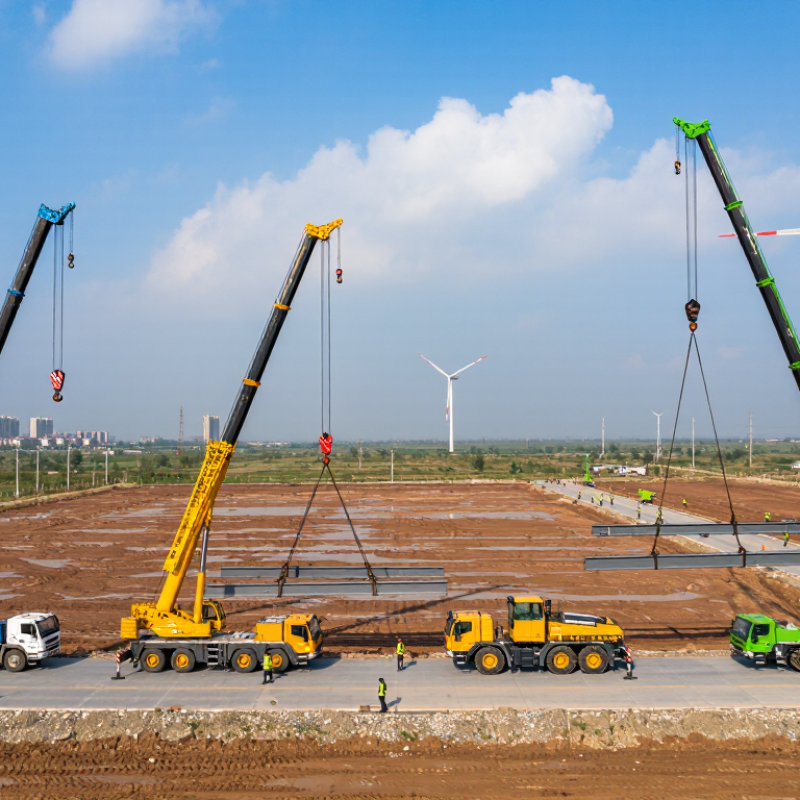
A telescopic crane is a mobile lifting machine with a boom that extends through nested steel sections. It can reach distant work areas without constant repositioning. Common configurations include truck-mounted, rough-terrain, and all-terrain cranes. Each suits different ground conditions, travel needs, and lifting schedules.
The operator controls hydraulic cylinders that push the boom sections outward or pull them inward. Hydraulic pressure also raises the boom and rotates the upper structure. A winch winds steel cable around a drum, moving the hook vertically. Counterweights help balance the machine, while outriggers widen its support base during lifting.
Before a lift, technicians check the load chart, boom length, working radius, and ground strength. For example, a 10-ton load may exceed the safe capacity when the boom reaches far across a construction site. Wind can also change the real risk. The machine may look stable, yet soft soil can allow one outrigger to settle.
Experienced crews inspect hydraulic hoses, pins, hooks, and safety indicators before operation. They also keep people outside the controlled lifting area. Load charts are not decoration; they guide every decision. Still, field conditions rarely match a perfect diagram. A rushed estimate or poor communication can create dangerous pressure, so careful planning remains essential.
Which Telescopic Crane Types Will Lead the 2026 Market?
Truck-mounted telescopic cranes are likely to lead the 2026 market.
They combine highway mobility, fast deployment, and moderate lifting capacity. MarketsandMarkets estimates the mobile crane market could grow from about USD 15.1 billion in 2024 to USD 20.8 billion by 2029. Infrastructure maintenance supports this demand.
All-terrain cranes should remain strong on bridges, wind projects, and urban construction sites.
Their adjustable suspension and multi-axle design handle uneven access roads better than standard truck units.
Rough-terrain cranes will serve shorter-distance projects, especially where compact dimensions matter.
A muddy access lane can decide the purchase.
Site experience still exposes a weakness.
Buyers often compare maximum lifting capacity first, while ground pressure, transport permits, and setup time create the real cost. The International Powered Access Federation’s safety reporting continues to emphasize planning, operator competence, and equipment inspection.
These details are not glamorous. They prevent expensive delays.
Crawler telescopic cranes may gain attention where soft ground and extended reach overlap.
However, their transport requirements remain a barrier for smaller contractors.
Forecasts are not promises. MarketsandMarkets and regional construction outlooks show healthy growth, but interest rates and infrastructure budgets may change buying priorities quickly.
The leading crane type in 2026 may therefore be the one that arrives fastest, not the one with the largest chart number.
How Do Telescopic Cranes Differ in Capacity, Reach, and Mobility?
2026 Top Telescopic Crane Types for Global Buyers
Telescopic cranes differ most in capacity, reach, and mobility. Reach is not capacity. A longer boom can reduce lifting strength at full extension. A 50-ton crane may lift 50 tons only within a short working radius. Its load chart, counterweight, outrigger spread, and ground condition decide the real result. EN 13000 requires documented load charts for mobile cranes, but buyers still need site-specific verification.
Truck-mounted telescopic cranes usually offer faster road travel and lower setup time. Rough-terrain models handle uneven construction sites with stronger off-road traction. All-terrain cranes combine highway speed with larger lifting capacity, although their transport planning is more demanding. Telescopic crawler cranes provide stability on soft ground, but their travel speed is limited. Mobility changes everything.
A 2024 mobile crane market report from Mordor Intelligence estimated the global market at roughly USD 17 billion in 2025, with continued growth expected through 2030. Fortune Business Insights also projected steady expansion, though its valuation differs because its market boundaries differ. The numbers are useful, not perfect. Buyers should compare rated capacity, maximum radius, transport weight, and setup time together. During practical inspections, a crane with a 40-meter boom may perform worse than a shorter model on a crowded site. Narrow roads, overhead cables, muddy soil, and frequent repositioning can quietly reduce productivity. A thoughtful buyer checks those details before trusting brochure figures.
Which Industries and Projects Suit Each Crane Type?
2026 Top Telescopic Crane Types for Global Buyers
Truck-mounted telescopic cranes suit urban maintenance, utility repairs, and small bridge projects. They travel quickly between sites and need limited setup space. Their main weakness is road access. A narrow street can matter more than lifting capacity. Rough-terrain telescopic cranes fit remote construction, industrial maintenance, and uneven ground. Large tires and four-wheel steering improve movement across compacted soil. Ground conditions decide.
All-terrain telescopic cranes serve highways, rail infrastructure, wind facilities, and large commercial projects. They combine highway mobility with strong lifting performance. The Global Wind Energy Council reported 117 GW of new wind capacity in 2023. That growth supports demand for flexible lifting equipment, although every turbine site does not suit a telescopic crane. Some components still require heavier crawler equipment. The choice is rarely simple.
Telescopic crawler cranes work well for precast plants, industrial modules, and repetitive lifts on soft ground. Their tracks spread pressure and reduce the need for extensive ground reinforcement. However, transport takes longer, and mobilization costs can rise.
This forecast suggests wider use, but it should not replace site-specific engineering. A crane may meet the load chart and still fail the project schedule. Access, wind exposure, setup radius, and operator visibility deserve equal attention. Real sites punish neat classifications.
How Can Global Buyers Select the Right Telescopic Crane?
2026 Top Telescopic Crane Types for Global Buyers?
How Can Global Buyers Select the Right Telescopic Crane?
Selecting a telescopic crane should begin with the worksite, not the brochure. Record the heaviest load, lifting radius, maximum height, and daily operating hours. A 25-ton crane may handle a factory beam easily, yet struggle with a lighter load at full reach. Check the load chart at the exact boom length and working radius. Small assumptions can create expensive delays.
Terrain changes the decision. Rough-terrain models suit uneven construction sites, while truck-mounted cranes support faster road travel between projects. Crawler telescopic cranes offer stability on soft ground, but transport planning becomes more demanding. Measure access roads, bridge limits, turning space, and setup areas before requesting quotations. A useful habit is marking the planned crane position with cones. It exposes clearance problems early.
Global buyers should verify safety documentation, local certification, spare-parts access, training, and service response times. Ask for inspection records and test procedures, not only performance figures. Fuel use, tire wear, hydraulic maintenance, and export packaging affect total ownership cost. In my experience, buyers sometimes overvalue maximum capacity and undervalue operator visibility. That choice can look efficient on paper. It may not be. Review the decision with an experienced lifting supervisor, then challenge the assumptions again.
| Telescopic Crane Type | Typical Rated Capacity | Typical Maximum Boom Length | Mobility and Terrain | Typical Setup Requirement | Best-Fit Applications | Key Selection Advantages | Main Limitations |
|---|---|---|---|---|---|---|---|
| Truck-Mounted Hydraulic Crane | Approximately 10–100 tonnes | About 10–60 metres | Fast road travel; suitable for paved roads and prepared construction sites | Usually fast deployment; outriggers are commonly required for lifting | Urban construction, utility work, plant maintenance, infrastructure projects and general contract lifting | Strong road mobility, relatively quick relocation and broad availability of service vehicles | Less suitable for soft ground, steep off-road routes and heavily congested sites |
| Rough-Terrain Telescopic Crane | Approximately 20–150 tonnes | About 15–60 metres | Designed for uneven, unpaved and moderately soft construction terrain; normally transported between distant sites | Outriggers are typically needed for maximum lifting performance | Building construction, industrial sites, oil and gas facilities, bridges and remote projects | High ground clearance, compact dimensions and good maneuverability on job sites | Road travel is slower and often requires transport permits or a low-loader |
| All-Terrain Telescopic Crane | Approximately 40–1,200 tonnes | About 30–100 metres, with optional lattice extensions on many models | Combines highway travel with limited off-road capability on prepared or firm ground | Detailed site planning and outrigger deployment are normally required | Wind-turbine components, petrochemical facilities, power plants, bridges and major infrastructure | High lifting capacity, long travel range and strong versatility across multiple work locations | High purchase and operating cost; transport planning, permits and ground-bearing checks are important |
| Crawler Telescopic Crane | Approximately 40–400 tonnes | About 20–70 metres | Tracks provide low ground pressure and good stability on prepared soft or uneven ground; not intended for long road travel | Often works without outriggers; assembly and transport preparation can take longer | Wind farms, infrastructure, industrial construction, bridge work and projects requiring long pick-and-carry movement | Excellent stability, low ground pressure and the ability to travel with a load within rated limits | Usually requires component transport and site assembly; slower between distant projects |
| Pick-and-Carry Telescopic Crane | Approximately 10–60 tonnes | About 8–35 metres | Compact and highly maneuverable on firm, level industrial floors and paved sites | Often requires little or no outrigger setup, depending on the lift and manufacturer limits | Factory relocation, precast handling, warehouse work, steel erection and indoor industrial maintenance | Can lift and travel in confined areas, reducing setup time and site traffic | Lower capacity and reach than most rough-terrain or all-terrain cranes; ground conditions still matter |
| Compact Telescopic Crane | Approximately 1–25 tonnes | About 5–30 metres | Small footprint; suitable for restricted-access sites, indoor areas and light off-road work | Generally quick to position; stabilizers or outriggers may be required for heavier lifts | Indoor construction, glass installation, residential projects, maintenance and narrow urban sites | Low transport burden, excellent access and reduced disruption in confined work areas | Limited lifting capacity, working radius and wind resistance compared with larger crane classes |
Buyer selection guide: Choose capacity from the complete load chart at the required working radius, not from maximum rated capacity alone. Confirm boom length, lift height, ground bearing pressure, transport regulations, wind limits, power system, operator availability, spare-parts support and regional safety compliance before purchase. The figures above are typical industry ranges; actual specifications vary by configuration, counterweight, boom angle, outrigger position and manufacturer.
Related Posts
-
What Are the Top Telescopic Jib Crane Manufacturers?
-
10 Best Crawler Crane Manufacturers Worldwide in 2026
-
How to Choose a Crane on a Crane for Global Projects?
-
The Best All Terrain Crane Models for Your Heavy Lifting Needs in 2023
-
What is an All Terrain Crane and How to Choose the Best One?
-
Why Choose an All Terrain Crane for Global Projects?